


First, How Big Is Your Puzzle?
The piece count is only a rough guide — the finished size on the box is what matters.
| Pieces | Typical finished size |
|---|---|
| 500 | 49 × 36 cm (Ravensburger) to 54 × 38 cm (Buffalo Games) |
| 500 or 750 large-format | about 69 × 52 cm |
| 1000 | 68–70 × 49–51 cm |
| 1500 | about 80 × 60 cm |
| 2000 | 98–100 × 67–75 cm |
| 3000 | about 121 × 80 cm |
| 5000 | about 152 × 102 cm |
Puzzle makers suggest a surface a few centimetres bigger than the puzzle on every side, plus room for loose pieces and the box. Our puzzle size calculator works out the space you need and which mats and boards fit.
The Four Types
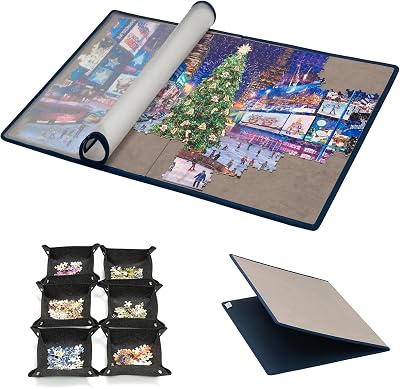
Roll-up mats. A felt or polyester sheet that you build on, then roll around a tube (inflatable, foam or cardboard) to store an unfinished puzzle. They cost the least and fit in a cupboard. The trade-offs: the felt can crease if the tube is shorter than the mat, and some owners find sections lift when rolled.
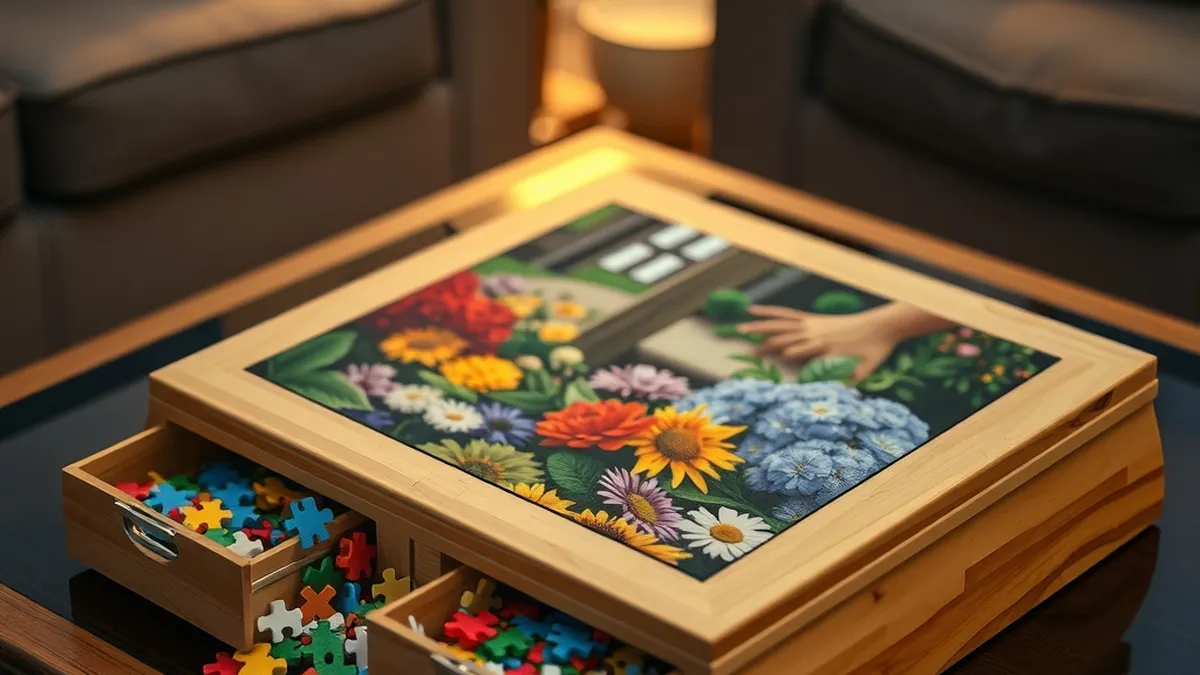
Folding boards. A rigid felt-covered board that folds in half, often with sorting trays and a cover. You can carry the puzzle from the table to a shelf without disturbing it — the best choice if the dining table is needed every night.
Tilting boards. A board with a stand that angles the puzzle towards you, so you're not bent over it. Good for long sessions or puzzling from the sofa.
Tables. Free-standing, sometimes with adjustable height or tilt, and with fold-out side panels for sorting. The most comfortable, but they need the floor space to leave one set up.


Mats and Boards by Puzzle Size
| For | Choose | Why |
|---|---|---|
| Up to 1,000 pieces | A board with at least 76 × 51 cm usable | Fits a 70 × 50 cm puzzle with a little margin |
| 1,000–1,500 pieces | A roll-up mat about 117–118 × 66 cm, or a board around 91–93 × 65 cm | Room for an 80 × 60 cm puzzle |
| 2,000 pieces | A board around 103 × 76 cm, or a mat about 127 × 76 cm | Fits a 98–100 × 75 cm puzzle |
| 3,000 pieces | A large mat around 150 × 100 cm | Fits a 121 × 80 cm puzzle |
Go by the usable area, not the label. A board sold "for 1,500 pieces" may still be too small for a particular 1,500-piece puzzle — compare the stated surface with the size on the box.
Sorting Makes the Biggest Difference
Separating edge pieces and grouping pieces by colour is what speeds up a big puzzle. Most folding boards include trays or drawers; if yours doesn't, a set of stackable sorting trays does the same job.

Keeping a Finished Puzzle
To keep a puzzle rather than break it up, glue it:
- Push the puzzle flat and slide baking paper underneath.
- Spread a thin layer of puzzle glue over the face with the applicator — don't let it pool.
- Let it dry fully before lifting. Ravensburger says its Puzzle Conserver is dry after about an hour; leave larger puzzles longer.
- Mount anything over 500 pieces on a backing board, then frame it with a frame about 2.5 cm larger than the puzzle on each side.
Prefer Building to Puzzling?
If you like the focus of a jigsaw but want something to display at the end, try a 3D wooden puzzle, a book nook or a LEGO Botanicals plant.
Frequently asked questions
What size puzzle mat do I need for 1000 pieces?
Most 1,000-piece puzzles finish about 68–70 × 49–51 cm. A board with at least 76 × 51 cm of usable area fits them; a roll-up mat sold for up to 1,500 pieces (about 117–118 × 66 cm) leaves room to sort.
Is a felt mat or a board better?
A felt mat costs least and stores in a cupboard. A board gives a rigid, flat surface you can carry with the puzzle on it, and usually adds sorting trays, drawers, a cover or a tilt.
Can you roll up a puzzle without losing pieces?
Usually. Roll it firmly around the tube from the short end and fasten the straps straight away. Some owners still find sections lift or the felt creases, so a board is safer for a puzzle you move often.
How do you glue and frame a finished puzzle?
Work on baking paper, spread a thin coat of puzzle glue over the face with the applicator, and let it dry before lifting. Ravensburger recommends a backing board for puzzles over 500 pieces, and a frame about 2.5 cm larger than the puzzle on each side.