



Why 1000 Pieces?
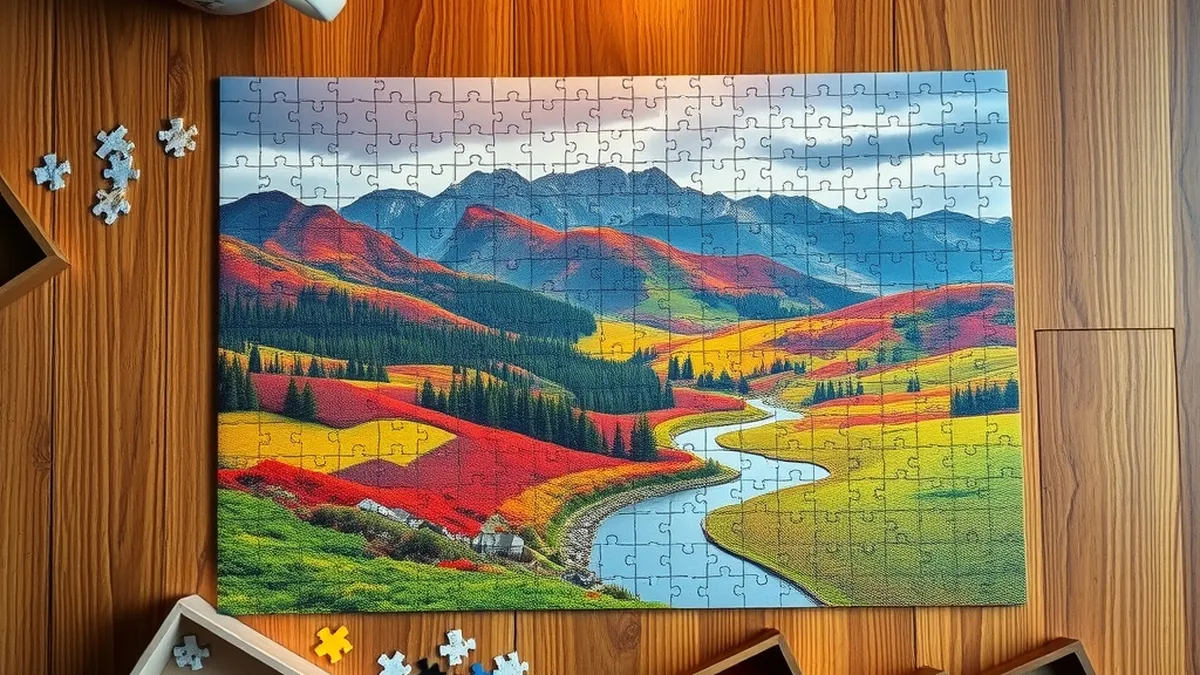
A 1000 piece puzzle is the standard adult jigsaw: big enough to take several evenings, small enough to fit on a dining table. Most finish at about 70 × 50 cm. That's the size to plan your table, mat or board around — our puzzle size calculator shows which mats and boards fit.
How Long It Takes
| Who | Typical time |
|---|---|
| Most adults (Galison's estimate) | 8–15 hours of active time, over 3–5 sessions |
| Keen puzzlers who time themselves (MySpeedPuzzling median) | About 3 hours 16 minutes |
| Competition record (Guinness, 2020) | 1 hour 40 minutes |
A 1000 takes roughly three times as long as a 500, not twice. Short sessions of an hour or two are easier on your eyes and back.
What Makes a 1000 Easy or Hard
- The image matters more than the count. Big areas of one colour — sky, snow, still water — are the hardest. Bold, distinct colours and a clear subject are easiest.
- Repeats and patterns (bookshelves, yarn, collages) look busy but sort well by colour. Fine-art images with soft brushwork are harder than they look.
- The cut. Ribbon (grid) cut puzzles have pieces in neat rows and are easier to start with. Random-cut puzzles, such as Cobble Hill, come in many odd shapes; Cobble Hill says they produce fewer "false fits".
- A poster or reference image helps a lot. Some brands include one; others rely on the box lid.
- Twist puzzles such as Wasgij show a clue on the box rather than the finished picture — save these for later.
How the Brands Differ
| Brand | What it's known for |
|---|---|
| Ravensburger | Thick board (2.1–2.2 mm), "Softclick" tight fit, linen-embossed paper to cut glare |
| Cobble Hill | Random-cut pieces, linen finish, thick blue board, poster in many boxes |
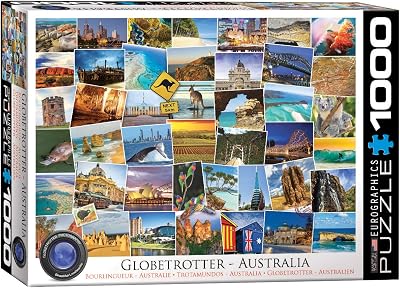
| EuroGraphics | Recycled blue board and vegetable-based inks; art and map designs |
| Galison | Ribbon cut, greyboard with 90% recycled content, minimal puzzle dust |
| Buffalo Games | "Perfect Snap" pieces, recycled board, bonus poster in many puzzles |
| Schmidt | Matte linen finish and many piece shapes |
| Clementoni | Made in Italy; Museum Collection of famous paintings |
From Australia and New Zealand: Blue Opal (classic cars and Aussie roadhouse scenes by Jenny Sanders), Journey of Something (a Melbourne studio working with Australian artists), Australian Geographic (wildlife art) and Holdson (Auckland, since 1939).


Puzzles With an Australian Theme


Many puzzles on Amazon Australia ship from Amazon's overseas warehouses, so check the delivery date at checkout, especially before Christmas.
A Method That Works
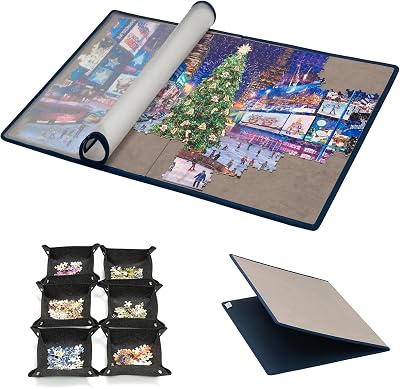
- Set up a space that can stay put — at least 61 × 91 cm of table, or a mat or board you can move. Use bright, even light.
- Study the picture for a minute: where are the distinct colours, the patterns, the plain areas?
- Turn every piece face up and pull out the edges. Expect about 124–126 edge pieces — roughly one in eight (Ravensburger's grid is 36 × 28 pieces). Build the frame first.
- Sort by colour and pattern into trays or box lids: text, faces, buildings, foliage, sky.
- Build distinct sections first, then fit them into the frame using the box or poster.
- Leave the plain areas for last and sort those by shape — heads and holes, number of knobs.
- Count before you panic. The real total is often a few pieces off 1000, and a "missing" piece is usually under the box lid or the table.

When You Finish
- Keep it: spread puzzle glue thinly over the face with the puzzle on baking paper, let it dry fully (Ravensburger says leave it a day), then mount anything over 500 pieces on a backing board before framing.
- Pass it on: bag the pieces, note any missing ones on the box, and take it to a puzzle swap. Many council libraries run them — Mildura, Belgrave, Toukley and Queanbeyan among others — so ask at your local library.
- Missing pieces: most brands don't send single pieces; Cobble Hill replaces new puzzles with factory defects.

Puzzling as a Sport in Australia
The Australian Jigsaw Puzzle Association runs state competitions and the 2026 National Championships at MSAC, Albert Park, Melbourne on 28–29 November 2026. Solo events usually use 500-piece puzzles; teams tackle 1000. At the 2025 World Championship in Spain, the individual winner finished a 500 in under 40 minutes.
Is It Good for You?
Puzzling uses several thinking skills at once, and a 2018 study found that people who had puzzled for much of their lives had better visuospatial skills. But in the same study, a month of daily puzzling made no measurable difference — and the study was funded by Ravensburger. Enjoy puzzles for the calm, not as brain training.
Browse all 1000 piece puzzles, or see puzzle mats and boards. Looking for a gift? Our gifts for crafters guide has ideas for every hobby.
Frequently asked questions
How long does a 1000 piece puzzle take?
Most people need about 4–15 hours of active time, spread over several sessions. Galison estimates 8–15 hours for most adults; keen puzzlers who time themselves on MySpeedPuzzling have a median of about 3 hours 16 minutes. The competition record is 1 hour 40 minutes.
How big is a 1000 piece puzzle?
About 70 × 50 cm finished for European brands such as Ravensburger and Clementoni, and about 68 × 49 cm (26.75 × 19.75 in) for US brands. Allow a surface of at least 76 × 51 cm, plus room to sort.
How many edge pieces are in a 1000 piece puzzle?
About 124–126, roughly one piece in eight. Ravensburger's 1000-piece grid is 36 × 28 pieces, which gives 124 edge pieces.
Are 1000 piece puzzles hard?
They're the standard adult challenge. The image matters more than the count: big areas of one colour (sky, snow, water), repeated patterns and random-cut pieces make a puzzle harder; bold, distinct colours and a poster make it easier.
What is a random-cut puzzle?
Pieces that don't sit in neat rows and columns and come in many unusual shapes. Cobble Hill is the best-known random-cut brand. Ribbon-cut (grid) puzzles, such as most Ravensburger and Galison puzzles, are usually easier for beginners.
Does doing jigsaw puzzles keep your brain sharp?
Puzzling uses several thinking skills, and a 2018 study linked lifelong puzzling with better visuospatial skills in older adults. But in the same study, a month of daily puzzling didn't measurably improve them, and it was funded by Ravensburger. Do it because you enjoy it.